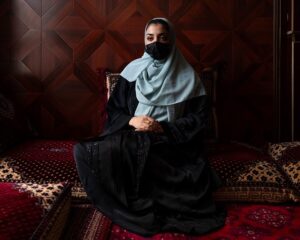
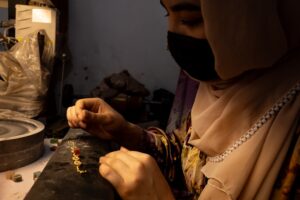
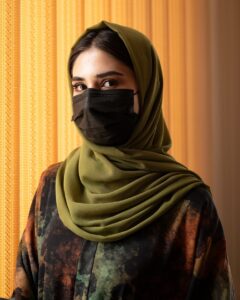
Diana Hashimi, rug designer and beauty entrepreneur.
“Hello, are you going to Kabul?”
“Yes.”
“Please wait here. We need confirmation from the local immigration authorities that you are allowed to enter Afghanistan.”
I move away from the baggage drop-off queue and wait. Twenty minutes later, I check in my suitcase, collect my boarding pass, eat a sandwich and make my way to the gate.
I have been waiting for this journey for a year. I have already spoken to many of the women I will meet, but during the nine-hour journey from Heathrow Airport to Kabul Airport, I cannot focus on the work ahead of me. My thoughts remain fixed on the fact that, while landing, I will cross the same sky from which, five years earlier, people fell to their deaths in a desperate attempt to be evacuated. They had clung to the landing gear of one of the C-17 military aircraft leaving Kabul, as the Taliban took control of the city in August 2021.
It will be the same runway that hundreds of fleeing people stormed. And it will be the same airport from which, in the weeks following the fall of Kabul, the main evacuation operations started. The final death toll from those days amounted to hundreds of people killed and injured: approximately 170 Afghan civilians and 13 US military personnel.
After skimming over the mountains, the plane landed on time at 7:20 a.m.
I am in Afghanistan.
I put on a hijab, and I find the Nove Caring Humans staff waiting for me. Over the next two weeks, I will meet many of the women who benefit from their projects. Through their stories, I will try to understand what it means for an Afghan woman today to receive an education, work and try to build a future for herself.
After passing through the checks and making our way past the relatives waiting in the arrivals area, some of them holding bouquets, we get into a car. From the window of the Corolla, I begin to observe the streets of Kabul.
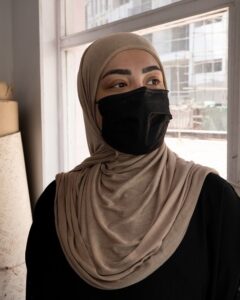
Michelle Popalzai, founder of La Michelle
“Everyone sees the construction sites and thinks there is progress. Real progress is when women are allowed to go to school.”
Michelle will tell me this a few days later, as she describes her own suffering and her sister’s. The Taliban’s return to the capital prevented her from taking up a scholarship: she could not leave for Germany, nor could she study marketing at university. Her thirteen-year-old sister, who desperately wanted to study, was given no choice either. Interrupted studies, lost plans and no way out plunged Michelle into months of depression: “Sitting at home is not the same as sitting in a classroom,” she explains. “I was struggling, but I still wanted to find something to do.”
Looking for a way to give a sense of purpose to her days, she began volunteering at a women’s rehabilitation centre for drug users, where sewing classes were also held. There, she realised that her passion for marketing and her entrepreneurial spirit were still alive. She offered to help the women sell and promote their products, enabling them to earn money and cover essential expenses. Helping them made her feel good, but it wasn’t enough. Her dream of starting a business had been reignited.
With 25,000 Afghanis, just over 300 euros, she started to buy fabric, thread and a sewing machine. One year after the Taliban’s arrival, and despite the growing restrictions, she founded her brand, La Michelle. A few months ago, she obtained an official licence from the Ministry of Industry and Commerce. Work did not replace school or university, but it certainly gave her back an active routine, with commitments, goals she wants to achieve and professional relationships she needs to cultivate.
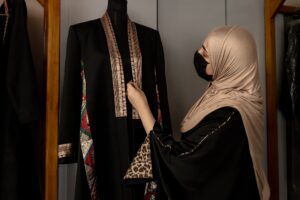
Today, Michelle has four female employees, and most of her customers are abroad. She found them mainly through her network of contacts, which has expanded over the years through the internet and social media. She has learned to use artificial intelligence to create posts and reels, prepare brochures and posters, and refine the designs for her bags, clothes and accessories.
Her case is not isolated. The Kabul that the Taliban retook is not the same Kabul they left twenty-five years ago. They returned to a city where the internet had arrived, where people had smartphones and were connected to a world that, although it may seem distant, is not. Technology has become one of the tools through which many women, excluded from most public spaces, education and many jobs, are trying to rebuild their own economic independence.
In Afghanistan, too, the internet has changed the way women can do business. Within the limits imposed by the authorities, many women are building their own businesses, earning an income for themselves and their families and contributing, in their own small way, to an economy in crisis.
Living rooms, bedrooms and small courtyards have become sewing workshops, offices and small packaging centres. Here the products are photographed with smartphones, orders are prepared and shipments are organised. Women often work from the toshak, the cushion or mattress used for sitting or sleeping, surrounded by fabrics, sewing machines and relatives coming and going.
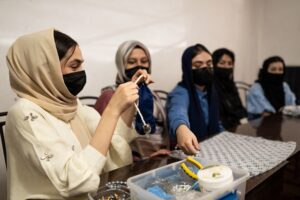
Women during a sewing and jewellery making course organised by entrepreneur Sheila Amiri.
Between one power outage and the next, they watch videos and online courses to learn a trade or improve their skills. They download applications: through WhatsApp, Instagram, TikTok and YouTube, women learn new skills, exchange information, look for job opportunities, find customers and support one another. Sometimes collaborations emerge. Or, in a country where meeting in public has become more difficult, they simply talk.
For some of them, these small businesses transform into opportunities to train others during the first orders, and then, into the first hires – almost always of other women.
Fathers, brothers and husbands, on the other hand, get involved in tasks that women cannot carry out freely precisely because they are women: trips, making deliveries and handling bureaucratic procedures.
During my trip to Kabul, I met many young female entrepreneurs who have started their own businesses over the past five years. Last year, some of them participated in the Women Business Prize organised by Nove Caring Humans, a national award open to women who run a business or have a business idea. The prize included financial support and three months of mentoring. There were more than 140 applications from 11 provinces, and three female entrepreneurs were awarded prizes during a ceremony in Kabul attended by the authorities. An additional, non-competitive prize was awarded by the Avvenire Foundation. The award ceremony was followed by a training programme, and, even today, some of the candidates continue to be involved in a new project, She Means Business – Peer Learning Circle.
The project consists of online meetings where participants discuss problems, solutions, strategies and opportunities. In addition to the online meetings, a WhatsApp group was also created and is actively managed by NOVE. The organisation takes part in the conversations, answers questions and encourages discussion among the entrepreneurs. Adiba and Shikeba, two of the participating entrepreneurs, told me more about it.
Adiba in her living room.
Adiba started a poultry business on the outskirts of Kabul and now has almost 2,000 chickens. She picked an activity that is unusual for a woman in Afghanistan, and there were not many people she could learn from. She discovered some tutorials by African farmers, through which she learned how to improve the feed and identify certain poultry diseases. Through the group, she found new ideas for addressing problems related to raw materials, particularly their purchase and import from other countries, now that the situation with Iran and Pakistan has made trade more complicated.
Shikeba, on the other hand, has built her business online. Thanks to the Peer Learning Circle, she received more information about the procedure for getting a business licence. She has not yet managed to obtain one, but it would give greater recognition to her online IT and AI courses. Through these courses, she has managed to engage more than 200 girls and boys across the country. Some have already started working as freelancers, allowing them to earn some money.
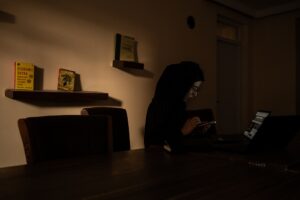
Shikeba during an online course.
What I hear and see in Kabul, however, does not reflect the whole of Afghanistan. In smaller and more remote cities, having access to even a small amount of start-up capital cannot be taken for granted. In Kabul, some of the girls tell me that they gathered their first funds by selling a gold bracelet, a necklace or a piece of jewellery they had received as a gift. These are not large sums, but they are enough to buy a sewing machine, some fabric, a new smartphone or a used laptop to work with.
Outside Kabul, however, getting started may take years, or it may not happen at all. Here, small loans, training and equipment can make the difference, allowing some women to turn an idea into their first business. This is what Nasrin Mawlany in Mazar-i-Sharif and Marzeiah Arifee in Daikundi, two of the winners of the Women Business Prize 2025, did.
The difficulties in Afghanistan are numerous, unpredictable and vary from one region to another. Every day there may be some new issue to resolve. An additional tax. A new checkpoint that lengthens the journey and causes someone to miss an appointment. A blackout that cancels an online order or interrupts a training course: A broken generator, a solar panel that no longer works.
An earthquake can also bring a business to a halt: last August’s earthquake damaged the workshop set up in a room of Nasrin’s home in Mazar-i-Sharif, forcing her to suspend the sewing and packaging of her products – reusable sanitary pads – for several days. Then there are the floods, which make travelling difficult, and tensions with Pakistan along the Durand Line, which slow down, or even halt, trade.
The complexity of Afghanistan rarely makes it into the news, which now covers the country less and less often. Emergencies make the news. Everything else is dismissed with: “Yes, but nothing new.”
That “nothing new” consists of girls who want to go to school but cannot. It consists of women who cannot leave their homes freely, work in most sectors or participate in public life.
And yet, in the meantime, Michelle keeps on working on her bags. As she tells me about her new idea of creating phone cases, she looks at me, smiles and says:
“I want to become the Afghan Dior.”
A special thanks to the Nove Caring Humans Kabul staff for the work they do every day and for making me feel at home.
And a thank you to the Rome staff for these months of collaboration and for helping make all of this possible.
Utilizziamo i cookie sul nostro Sito Web per offrirti l'esperienza più pertinente ricordando le tue preferenze e ripetendo le visite. Cliccando su "Accetta tutto", acconsenti all'uso di TUTTI i cookie. Tuttavia, puoi visitare "Impostazioni cookie" per fornire un consenso controllato.
Utilizziamo i cookie sul nostro Sito Web per offrirti l'esperienza più pertinente ricordando le tue preferenze e ripetendo le visite. I cookie categorizzati come 'necessari' sono essenziali per l'utilizzo e il funzionamento delle funzionalità base del sito. Gli altri cookie verranno registrati solo con il tuo consenso.
I cookie necessari sono essenziali per le funzioni proprie del sito e assicurano anonimamente le funzionalità basiche e di sicurezza del sito stesso.
Cookie
Durata
Descrizione
cookielawinfo-checkbox-analytics
11 months
This cookie is set by GDPR Cookie Consent plugin. The cookie is used to store the user consent for the cookies in the category "Analytics".
cookielawinfo-checkbox-functional
11 months
The cookie is set by GDPR cookie consent to record the user consent for the cookies in the category "Functional".
cookielawinfo-checkbox-necessary
11 months
This cookie is set by GDPR Cookie Consent plugin. The cookies is used to store the user consent for the cookies in the category "Necessary".
cookielawinfo-checkbox-others
11 months
This cookie is set by GDPR Cookie Consent plugin. The cookie is used to store the user consent for the cookies in the category "Other.
cookielawinfo-checkbox-performance
11 months
This cookie is set by GDPR Cookie Consent plugin. The cookie is used to store the user consent for the cookies in the category "Performance".
viewed_cookie_policy
11 months
The cookie is set by the GDPR Cookie Consent plugin and is used to store whether or not user has consented to the use of cookies. It does not store any personal data.
sono i cookie necessari per consentire la navigazione del sito e l’utilizzo di alcuni prodotti e servizi. Vengono utilizzati, ad esempio, per riconoscere l’utente che si è autenticato alla propria casella di posta elettronica e mantenere aperta la sessione anche quando visita altre pagine del sito, oppure per garantire alcune misure di sicurezza del sito e monitorarne il corretto funzionamento.
I cookie di performance sono utilizzati al fine di capire e analizzare le performance del sito per aiutare e migliorare la user experience dei visitatori.
questi cookie vengono utilizzati per monitorare le performances del sito, per
esempio per conoscere il numero di pagine visitate o il numero di utenti che hanno visualizzato una determinata sezione. L’analisi di questi cookie genera dati statistici anonimi e aggregati senza riferimento alcuno all’identità dei navigatori del sito. Sono utili anche per valutare eventuali modifiche e miglioramenti
da apportare al sito stesso.
Si tratta dei cookie che consentono di condividere anche con altri utenti i contenuti del sito che si sta visitando o di manifestare la vostra opinione in merito. Sono i cookie
tipicamente utilizzati per attivare le funzioni “Mi piace” o “Segui” dei Social Network quali Facebook e Twitter, solo per citarne alcuni. Queste funzioni consentono ai Social Network di identificare i propri utenti e raccogliere informazioni anche mentre navigano su altri siti.
 Today, Michelle has four female employees, and most of her customers are abroad. She found them mainly through her network of contacts, which has expanded over the years through the internet and social media. She has learned to use artificial intelligence to create posts and reels, prepare brochures and posters, and refine the designs for her bags, clothes and accessories.